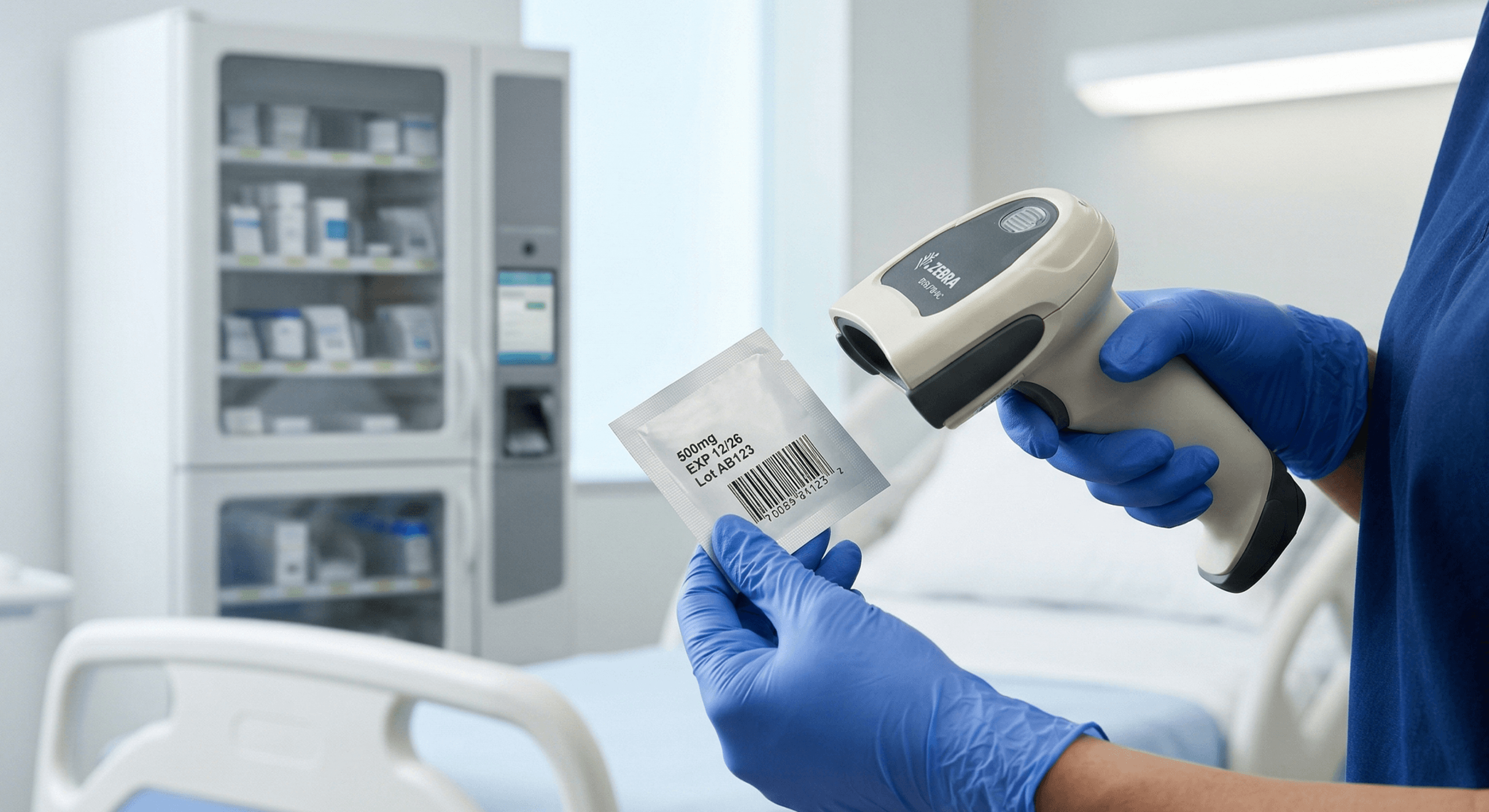
Medication administration is one of the most complex, high-frequency, and high-risk activities within a hospital environment. For inpatient settings, medication rounds must balance speed, accuracy, and traceability while adapting to shift patterns, patient conditions, and clinical priorities.
The internationally recognized 5 Rights of Medication Administration — Right Patient, Right Drug, Right Dose, Right Route, and Right Time — form the foundation of safe medication practice. Yet achieving the 5 Rights consistently across every round, every ward, and every shift requires more than manual checks. It requires integrated systems, digital data, and coordinated workflows.
At Omni-Health, we partner with hospitals to implement a closed-loop inpatient medication administration model, integrating Hospital Information Systems (HIS), pharmacy automation, Omnicell Automated Dispensing Cabinets (ADC), Barcode Medication Administration (BCMA), and bedside medication computer carts such as OmniKart — enabling safer, faster, and more efficient delivery of medication to patients.
Why the 5 Rights Matter in Inpatient Settings
Research shows that 60–70% of preventable medication errors occur during the administration stage, where nurses must balance multiple variables under time pressure.
A closed-loop system reduces variability and risk by ensuring medication information flows directly from physician → pharmacy → dispensing → bedside → documentation.
Global evidence shows:
- BCMA reduces medication errors by 30–55%
- Closed-loop medication systems reduce adverse drug events by up to 41%
- Automated Dispensing Cabinets (ADCs) achieve 98%+ medication inventory accuracy
- Bedside medication carts reduce nursing walking time by 30–40%
- Unit-dose packaging reduces pharmacy prep time by 30–60

How Omni-Health Supports Each Stage of the 5 Rights
Right Patient
- HIS integration
- Barcode scanning of patient wristbands
- Bedside verification via OmniKart
- BCMA for patient–med match checks
This ensures medication is administered to the correct patient and reduces identity-based errors during rounds and shift transitions.
Right Drug
- Omnicell ADC dispensing
- Verified pharmacy orders
- Automated labeling & drug identification
- QR/Barcode tracking through the chain
Automated Dispensing Cabinets prevent unauthorized access and reduce drug-pick errors.
Right Dose
- Dose-wise / unit-dose packaging
- ADC dose control dispensing
- Barcode validation of dosage before administration
- Pharmacy verification for clinical accuracy
Automated packaging significantly reduces manual dose calculations and transcription.
Right Route
- Clear labeling and instruction visibility
- ADC route confirmation
- Bedside screen display via OmniKart
- Reduced cognitive load for nurses
Proper route documentation is critical for IV, oral, subcutaneous, and other administration routes.
Right Time
- Digital scheduling via HIS
- ADC pick-time coordination
- Bedside scanning to confirm timing
- Real-time documentation
Right Time directly impacts therapeutic efficacy for antibiotics, anticoagulants, insulin, and pain medication.

Closed-Loop Workflow Components Integrated by Omni-Health
Omni-Health integrates:
- HIS & physician digital prescribing
- Pharmacy verification & dispensing
- Omnicell ADC (Automated Dispensing Cabinets)
- Barcode / QR medication scanning (BCMA)
- Dose-wise packaging & labeling
- OmniKart medication computer carts (bedside administration)
- Real-time data logging & documentation
This creates a digital chain from order → verification → dispensing → transport → bedside → documentation.

(OmniKart reference: https://www.omnikart.net)
Benefits for Healthcare Decision-Makers
For Executive Leadership (CEO, COO, CFO)
- Reduces preventable harm costs
- Improves workforce sustainability
- Delivers measurable ROI via automation
- Supports digital transformation agendas
For Clinical & Middle Management (Pharmacy, Nursing, Ops)
- Standardizes medication workflows
- Reduces interruptions and rework
- Minimizes paper documentation
- Improves compliance and audit readiness

Why Integration Matters More Than Devices
Individual technologies (ADC, BCMA, carts, HIS, packaging machines) deliver value on their own — but the highest medication safety performance occurs when systems speak to each other.
Omni-Health ensures these components are deployed as an ecosystem, rather than isolated devices, supporting:
✔ Interoperability
✔ Traceability
✔ Real-time verification
✔ Closed-loop documentation
Omni-Health as Your Systems Integration Partner
Omni-Health provides:
- Workflow assessment & redesign
- System interoperability & integration
- Deployment & staff onboarding
- Compliance alignment
- Lifecycle support & service
We work with hospital groups, inpatient facilities, and private healthcare networks to modernize inpatient medication safety through technology-led transformation.
Frequently Asked Questions
Does this replace nurses or pharmacists?
No — it reduces manual tasks so clinicians can focus on patient care.
Can a closed-loop system be implemented in phases?
Yes. Integration can mature step-by-step depending on existing infrastructure.
What is the ROI timeline?
Typical ROI is 24–36 months, influenced by volume, digital maturity, and scale.
Do Omnicell ADCs work with OmniKart carts?
Yes — Omni-Health supports workflow optimization between the dispensing cabinet and the bedside cart.
Do we need to overhaul our HIS first?
Not necessarily. Systems can be layered on top of existing HIS environments.
Invitation to Healthcare Leaders
Hospitals and healthcare networks looking to modernize inpatient medication workflows and strengthen patient safety can partner with Omni-Health to design and deploy closed-loop medication administration systems tailored to their clinical and operational needs.
To explore strategies, roadmap planning, or implementation models, connect with us at:
www.omnihealth.com