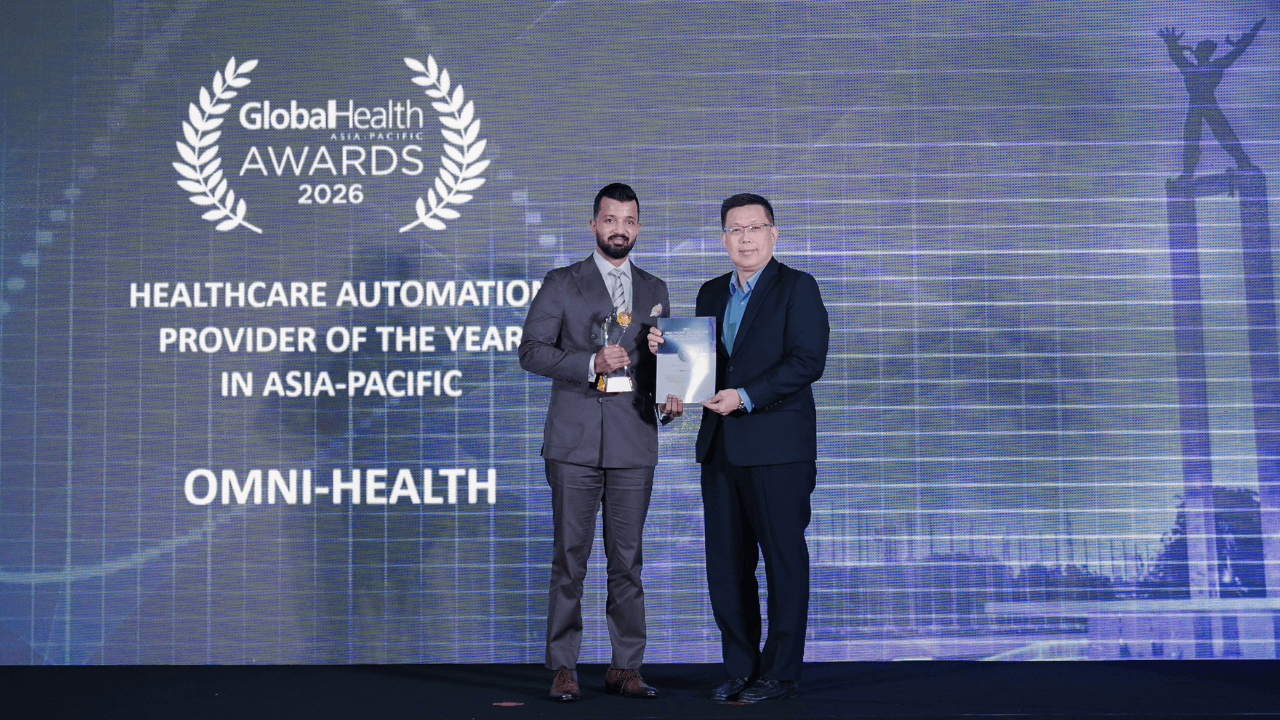
A Patient Should Never Be Harmed by a Preventable Medication Process Failure
Every medicine given inside a hospital passes through a chain of decisions.
A doctor prescribes it.
A pharmacist verifies and dispenses it.
The medicine is stored and transported.
A nurse identifies the patient and administers it.
The administration is documented and the patient is monitored.
When this chain depends heavily on handwriting, memory, manual picking, paper records, repeated data entry and disconnected systems, every additional manual step can become another opportunity for error.
Sri Lanka has already seen the human consequences that can occur when medication systems fail.
In April 2023, Newswire reported the death of a seven-year-old child following what was reported as an incorrect prescription at a divisional hospital. According to the report, previously used prescription paper contributed to medicines intended for an adult being dispensed to the child.
More recently, medicine quality has also remained under scrutiny. In December 2025, the Daily Mirror reported that 93 medicines had failed quality tests during 2025, citing the Medical Supplies Division of the Ministry of Health. The same report stated that 600 medicine quality failures had been recorded since 2017.
By 5 August 2026, the Daily Mirror reported, again citing the Medical Supplies Division, that 39 medicines had failed quality tests during 2026 and approximately 650 quality failures had been recorded since 2017.
These figures should concern every healthcare leader.
But they should also push us toward a more important question:
How much preventable risk are we still accepting simply because “this is how hospitals have always worked”?
The Global Statistics Make the Case for Change
Medication safety is not only a Sri Lankan challenge.
The World Health Organization’s Global Patient Safety Report 2024 states that approximately 1 in 20 patients globally experiences preventable medication-related harm.
The prevalence was approximately:
- 5% globally
- 7% across studies from low- and middle-income countries
- approximately 9% in the WHO South-East Asia Region
- and almost one-quarter of preventable medication-related harm was severe or life-threatening.
Perhaps even more relevant to healthcare leaders in developing markets, WHO found that while around 53% of preventable medication-related harm globally occurs during ordering and prescribing, the proportion rises to almost 80% in low- and middle-income countries.
WHO also estimates that medication errors cost the global economy approximately US$42 billion every year, while harm related to medicines and therapeutic options represents nearly 50% of preventable harm in medical care.
These are not simply clinical statistics.
For hospital leadership, they represent operational risk, financial risk, legal exposure, reputational risk and, most importantly, patient risk.
Sri Lanka Is Already Moving Toward a System-Level Response
There is an important positive development.
In March 2026, Sri Lanka formally launched its National Action Plan on Medication Safety 2026–2030 as part of a broader national healthcare quality and patient-safety strategy.
WHO Sri Lanka describes the plan as taking a system-wide approach across the entire medication pathway — from prescribing and dispensing to administration and monitoring.
Sri Lanka is also strengthening its response to substandard and falsified medical products. In June 2026, WHO reported that the country was developing a National Action Plan specifically addressing these risks with the involvement of the NMRA and other stakeholders.
This creates an important opportunity for hospital leadership.
National policy can establish the direction. Hospitals must build the operational infrastructure that makes safer medication management possible every day.
That is where digitalization, automation and intelligent system integration become increasingly important.
From Manual Medication Management to a Closed-Loop System
The future of medication safety should not depend on one machine.
It depends on connecting the complete medication journey.
A modern closed-loop medication workflow can connect:
Physician Order → Pharmacy Verification → Automated Dispensing → Secure Ward Storage → Patient-Specific Medication Preparation → Bedside Patient Verification → Administration → Electronic Documentation → Inventory & Audit Data
Instead of relying on multiple independent manual checks, technology creates additional digital checkpoints throughout the process.
At Omni-Health, our focus is on integrating these technologies into the hospital workflow rather than introducing automation as isolated equipment.
1. Start with a Digital Prescription

Medication safety begins before a tablet or injection reaches the pharmacy.
Electronic prescribing and Hospital Information System integration can reduce dependence on handwritten prescriptions and repeated transcription.
Depending on the hospital’s clinical information system and configuration, digital workflows can also support checks relating to dosage, duplicate therapies, allergies and other prescribing risks.
For hospital leaders, the objective should be simple:
The medication order should move digitally from the prescribing clinician to the pharmacy without unnecessary manual re-entry.
Every transcription step removed is one less opportunity to introduce an avoidable error.
2. Automate Pharmacy Dispensing and Unit-Dose Preparation

Hospital pharmacies frequently manage thousands of medication movements.
Under purely manual systems, pharmacists and technicians must repeatedly identify, pick, count, package, label and verify medicines.
Automation can introduce additional safeguards.
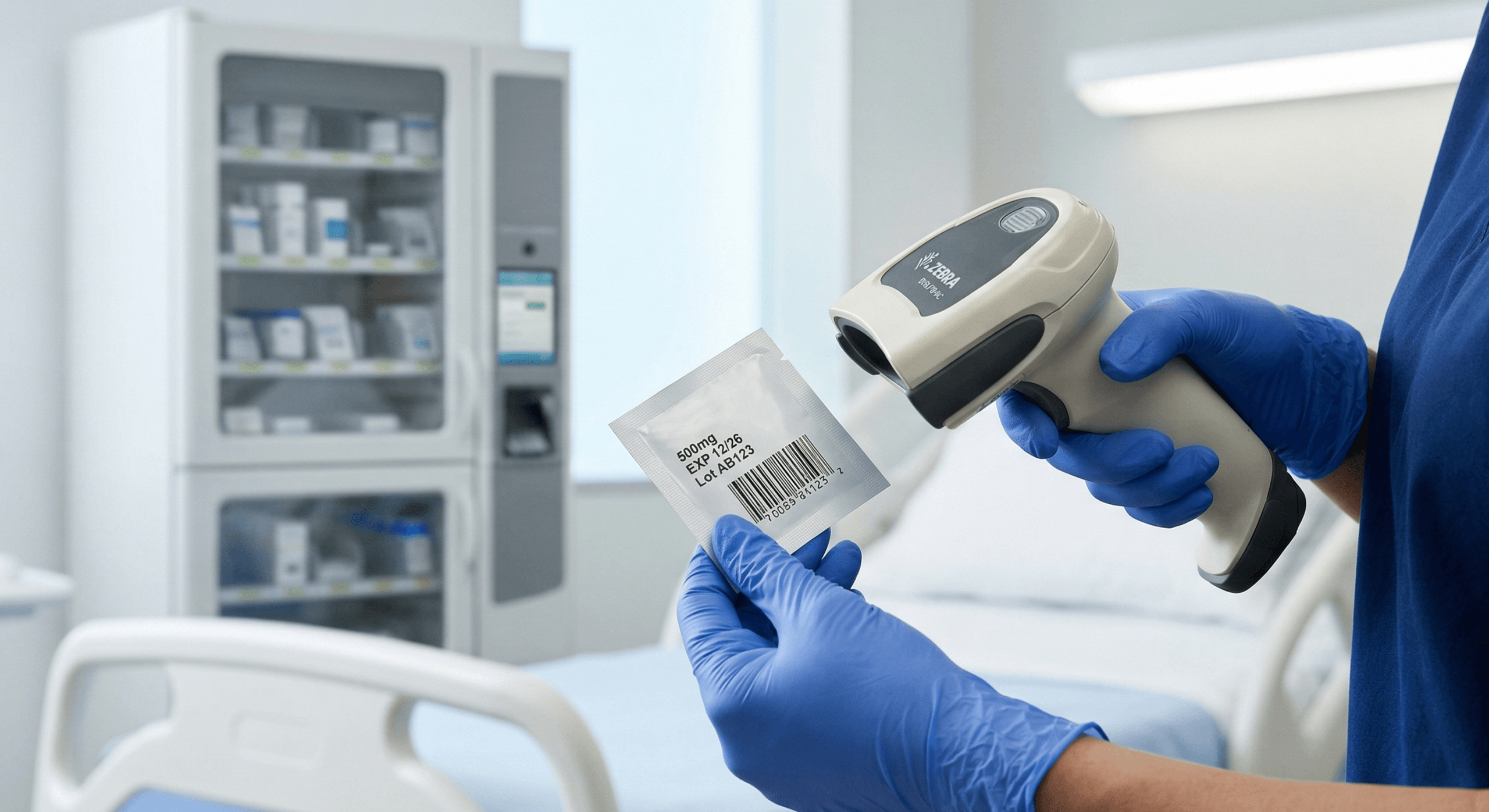
Modern automated tablet dispensing and packaging systems can support patient-specific dispensing, barcode or RFID verification, automated inventory controls, dose packaging and automated inspection.
Recent evidence supports this direction.
A 2026 systematic review of automated unit-dose dispensing systems reported that the studies reviewed showed reductions in medication errors of approximately 45–70%, while one integrated unit-dose and barcode workflow reduced harmful medication-administration errors from 3.0% to 0.3%. The authors also emphasized that implementation quality, workflow redesign and staff training remain critical.
Technology therefore does not eliminate professional responsibility.
It gives healthcare professionals stronger tools with which to exercise that responsibility.
3. Bring Automated Dispensing Closer to the Ward
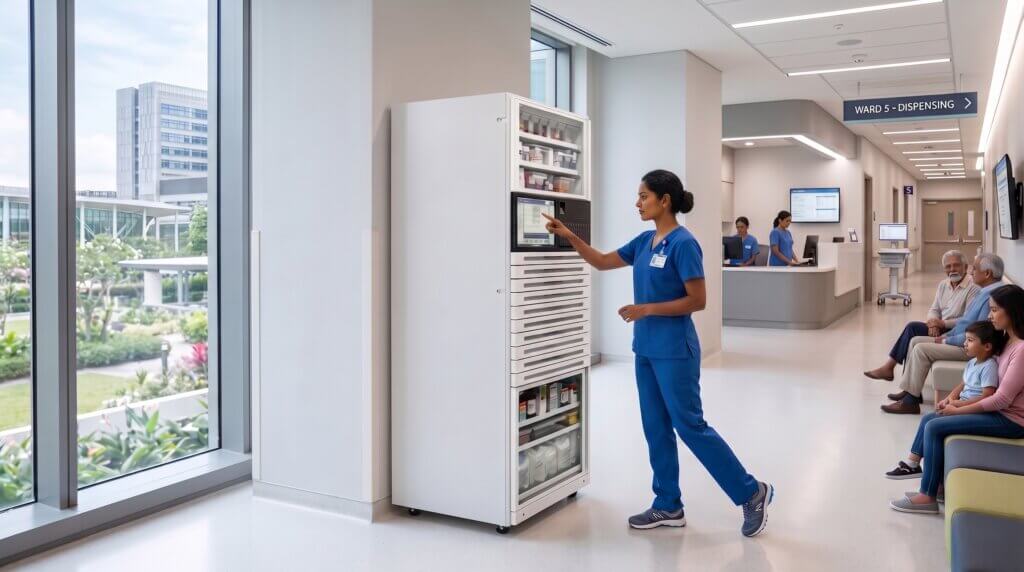
One of the biggest opportunities for inpatient medication management is the Automated Dispensing Cabinet (ADC).
Instead of maintaining unrestricted or heavily manual ward medication stores, ADCs provide controlled access to medications while improving visibility over what was accessed, by whom and for which patient.
The Omni-Health portfolio includes the Omnicell XT Automated Dispensing Cabinet, designed to support secure medication storage, inventory tracking, medication access control and integration with electronic hospital systems.
A 2026 systematic review examining ADCs and nurse-related medication errors found that implementation was generally associated with reductions in reported medication errors, particularly wrong-drug, wrong-dose and omission errors, while also identifying improvements in medication access and workflow. The authors appropriately cautioned that results differ between institutions and implementation models.
That distinction matters.
Buying technology is not the transformation. Designing the correct workflow around that technology is.
4. Verify the Patient at the Bedside
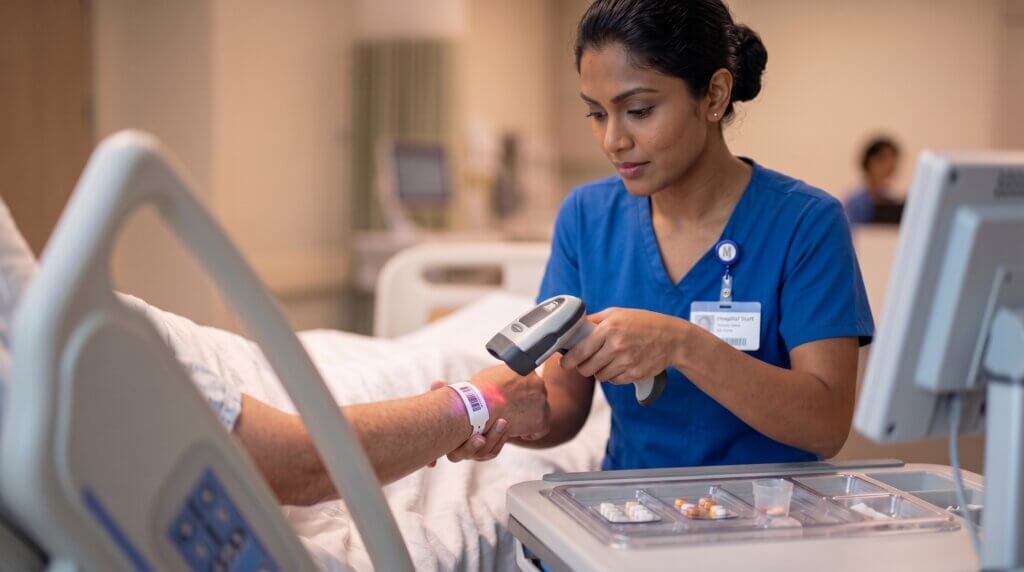
One of the strongest principles in medication administration remains the familiar 5 Rights:
Right Patient.
Right Drug.
Right Dose.
Right Route.
Right Time.
But expecting busy nurses to maintain these safeguards using memory, paper lists and repeated visual checks alone places enormous pressure on the individual.
Digital bedside verification can add another layer of protection.
Using Barcode Medication Administration (BCMA), the patient’s identification wristband can be scanned and matched against the medication before administration.
Omni-Health’s closed-loop model can integrate Hospital Information Systems, pharmacy systems, Automated Dispensing Cabinets, barcode verification and OmniKart, bringing medication information and secure medication storage closer to the bedside.
OmniKart can also integrate with Omnicell ADC workflows, supporting patient-specific medication transport in secured drawers from the dispensing point to the bedside.
The objective is not to make nursing more complicated.
It is the opposite.
Technology should reduce the number of decisions nurses must make from memory while giving them stronger verification at the point where the medication meets the patient.
5. Build Traceability Into the Medication Supply Chain

Patient safety is not limited to selecting the correct medicine.
Hospitals must also know:
- what stock they have,
- where it is located,
- when it expires,
- who accessed it,
- what needs replenishment,
- and how quickly affected stock can be identified when a recall occurs.
The NMRA maintains a medicines recall and revocation system specifically to support the removal of unsafe, ineffective or substandard medicines from the market.
Hospital inventory automation can complement regulatory action through stronger internal visibility and traceability.
Omni-Health solutions such as automated inventory management, controlled dispensing and electronic transaction records can help healthcare organizations create more accountable medication workflows.
This becomes particularly important when hundreds or thousands of medication units may already be distributed across pharmacies, wards and clinical departments.
What Automation Cannot Do
Responsible healthcare technology leadership also requires acknowledging the limits of technology.
Automation cannot make a substandard medicine safe.
Quality assurance, procurement governance, laboratory testing and strong regulation remain essential.
Automation also cannot guarantee that a patient will never experience an unpredictable allergic reaction or adverse drug reaction.
What technology can do is reduce avoidable process variation, strengthen identification and verification, create audit trails, improve inventory visibility, support known-allergy checks where clinical systems are integrated, and make it easier to identify where a medication has moved through the organization.
This distinction is essential.
The goal should never be “replace clinicians with technology.”
The goal should be:
Use technology to protect clinicians and patients from avoidable system failures.
AI Should Become the Intelligence Layer — Not the Decision Maker
Once medication workflows are digitized, hospitals create something equally valuable: structured operational data.
That data can support the next generation of healthcare automation.
AI-enabled analytics can increasingly assist organizations with areas such as:
- identifying unusual medication-utilization patterns,
- forecasting medicine demand,
- detecting inventory anomalies,
- highlighting potential stock shortages,
- supporting expiry management,
- prioritising pharmacy workload,
- analysing operational bottlenecks,
- and identifying patterns that deserve clinical or managerial review.
But responsible healthcare AI must remain human-supervised, clinically governed and auditable.
AI should strengthen the decisions of pharmacists, nurses and physicians — not remove professional accountability.
Why This Matters to CEOs and Hospital Boards
Medication automation is sometimes incorrectly viewed as a pharmacy equipment purchase.
It is much bigger than that.
For a CEO, COO or Hospital Director, medication automation can form part of the organization’s patient-safety infrastructure.
For the Head of Pharmacy, it can improve control, visibility and standardization.
For Nursing Leadership, it can reduce unnecessary manual steps and allow clinicians to spend more time with patients.
For Quality and Risk teams, digital transaction histories can strengthen auditability and incident investigation.
For IT leadership, an integrated medication ecosystem creates a foundation for interoperability, analytics and future AI adoption.
And for patients and families, it provides something far more important:
confidence that the hospital is designing systems to prevent avoidable mistakes before they reach the bedside.
A Practical Roadmap for Sri Lankan Hospitals
Hospitals do not need to automate everything on day one.
A responsible transformation can begin with a focused workflow assessment.
Phase 1 — Understand the Current Risk
Map the complete medication journey from physician order to administration.
Identify manual transcription, uncontrolled storage, repeated data entry, medication retrieval delays, inventory gaps and bedside verification weaknesses.
Phase 2 — Establish Baseline Data
Measure medication incidents, omitted doses, dispensing turnaround time, ward stock-outs, expiry losses, nurse medication-round time and pharmacy workload.
Without baseline measurements, transformation cannot be properly evaluated.
Phase 3 — Pilot a High-Risk Workflow
Begin with a pharmacy, intensive-care environment, high-volume ward or another area where medication complexity justifies automation.
Phase 4 — Integrate, Don’t Isolate
Connect the Hospital Information System, pharmacy workflow, automated dispensing, inventory control and bedside medication administration wherever technically and clinically appropriate.
Phase 5 — Measure and Scale
Evaluate safety, efficiency, user adoption and operational performance before expanding across additional wards and facilities.
The Question Is No Longer Whether Healthcare Will Become More Automated
Sri Lanka’s healthcare sector is entering a period where patient safety, workforce limitations, digital transformation and increasing clinical complexity are converging.
At the same time, Sri Lanka’s National Action Plan on Medication Safety 2026–2030 is creating a clear national direction toward safer systems.
Hospitals now have an opportunity to move from reactive incident management toward preventive system design.
At Omni-Health, we believe that the strongest healthcare technology does not replace the people delivering care.
It removes unnecessary risk from their workflow.
Automated dispensing.
Digital prescriptions.
Secure medication storage.
Barcode patient verification.
Unit-dose packaging.
Real-time inventory visibility.
Closed-loop documentation.
AI-ready healthcare data.
Individually, each technology solves a problem.
Connected together, they can create a safer medication ecosystem.
For Sri Lankan healthcare leaders, medication automation should no longer be viewed simply as a technology upgrade.
It should be viewed as an investment in patient safety.
Building a Safer Medication Workflow with Omni-Health
Omni-Health works with healthcare organizations to assess existing workflows and integrate pharmacy automation, Automated Dispensing Cabinets, medication packaging and dispensing technology, inventory management, bedside medication solutions and hospital-system integration.
Rather than starting with a product, we start with the workflow:
Where can an error occur?
Where is staff time being lost?
Where is visibility missing?
Where can technology create another layer of safety?
For hospital CEOs, directors, pharmacy leaders and operations teams considering the next stage of healthcare automation in Sri Lanka, the first step does not need to be a full-scale implementation.
It can begin with one workflow, one department and one measurable patient-safety objective.
Omni-Health — Enhancing Patient Care Through Operational Efficiency.
Frequently Asked Questions
What is medication automation in a hospital?
Medication automation uses technologies such as electronic prescribing, automated dispensing cabinets, unit-dose dispensing systems, barcode identification, electronic inventory management and bedside verification to reduce manual processes across the medication journey.
Can automation prevent all medication errors?
No. No technology can eliminate every medication error, adverse reaction or medicine-quality problem. Properly implemented systems can, however, introduce additional safeguards, reduce manual process variation and improve traceability.
What is an Automated Dispensing Cabinet?
An Automated Dispensing Cabinet is a secure computer-controlled medication storage and dispensing system used near the point of care. It can control medication access, record transactions, improve inventory visibility and integrate with hospital information systems.
Why is closed-loop medication management important?
Closed-loop medication management digitally connects the medication journey from prescribing and pharmacy verification through dispensing, patient identification, administration and documentation. This reduces disconnected manual steps and creates stronger accountability throughout the workflow.
Is Sri Lanka introducing stronger medication-safety policies?
Yes. Sri Lanka launched its National Action Plan on Medication Safety 2026–2030 in March 2026, covering the full medication-use pathway from prescribing through dispensing, administration and monitoring.